The Powerful Personal Development System That Actually Sticks
Table of Contents
ToggleWhat if I told you that your personal development journey may have been designed to fail?
Not because you’re lazy.
Not because you lack ambition.
Not because you have an identity problem.
And definitely not because you haven’t bought enough books.
You probably have the books.
You’ve attended the seminar.
You’ve watched the videos.
You’ve joined the course.
You’ve listened to the podcast.
You’ve written the goals.
You’ve had that beautiful Sunday evening where you suddenly decide:
“This time, everything is going to change.”
And for a few days, it does.
You wake up early.
You journal.
You meditate.
You read.
You exercise.
You write affirmations.
You look at your vision board.
You feel unstoppable.
Then Monday happens.
Work gets busy.
A meeting runs late.
You’re tired.
Your phone is next to you.
One small thing gets missed.
Then another.
And suddenly you’re back to your old routine.
The motivation disappears.
The notebook closes.
The goal gets forgotten.
And you start asking yourself the question that hurts the most:
“What’s wrong with me?”
What if nothing is wrong with you?
What if the problem is the system you were given?
That is the idea I want to explore here.
Because personal development has spent decades teaching us how to become inspired.
But inspiration isn’t the same thing as transformation.
A seminar can change your mood.
A book can change your thinking.
A course can give you knowledge.
A powerful conversation can give you clarity.
But what happens on Tuesday morning?
That’s where your real personal development journey begins.
The question isn’t:
“How motivated am I?”
The question is:
“What system makes the right behaviour easier to repeat?”
And that’s where an AI-powered personal development system becomes interesting.
Not as another productivity app.
Not as another chatbot telling you what to do.
But as a personalised operating system built around who you are, what you value, where you want to go and what you need to do next.
The goal isn’t to spend three hours every morning becoming a better version of yourself.
The goal is to build something simple enough that you can actually use it.
Even on a bad day.
Especially on a bad day.
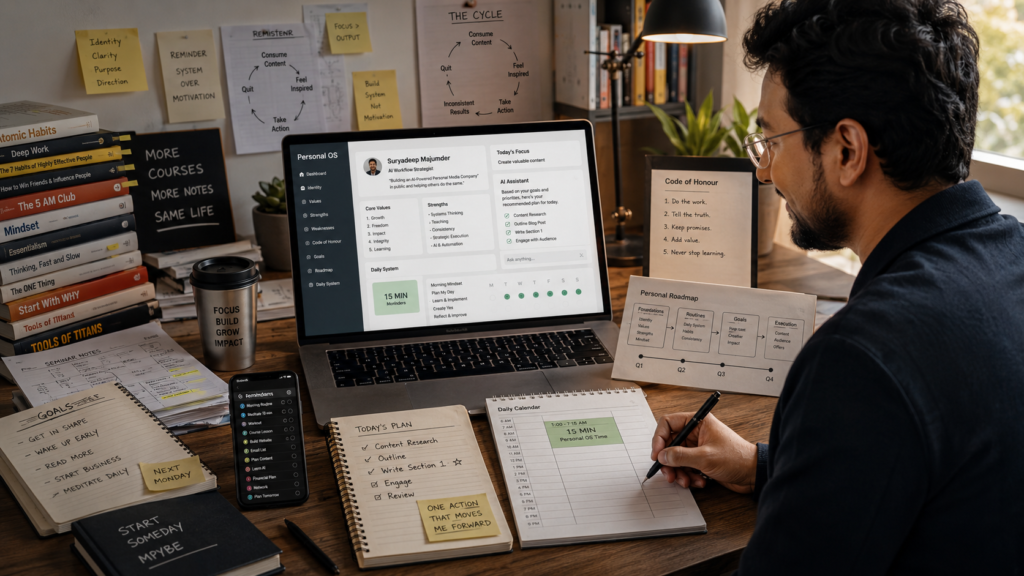
Why personal development keeps failing you
Let’s start with something uncomfortable.
The personal development industry often gives you more information when your real problem is execution.
You read:
- Atomic Habits
- Think and Grow Rich
- The 7 Habits of Highly Effective People
- The Power of Now
- Awaken the Giant Within
- countless newsletters
- countless Instagram posts
- countless YouTube videos
And every new idea feels useful.
So you collect another one.
Then another.
Then another.
Eventually, your brain contains 47 different systems for waking up at 5 AM.
You’ve got 12 different journaling methods.
Seven goal-setting frameworks.
Three meditation techniques.
Five productivity systems.
And absolutely no idea which one you’re actually supposed to follow tomorrow morning.
That’s not a lack of knowledge.
That’s system overload.
A personal development system should do the opposite.
It should reduce the number of decisions you have to make.
It should answer:
Who am I?
What matters to me?
What am I trying to build?
What should I do today?
When should I do it?
How will I know whether I’m progressing?
That’s it.
The system should make the path clearer.
Your problem may not be your identity
The transcript begins with a provocative idea:
Maybe your personal development journey has been wired for you to fail.
I would sharpen that.
You may have spent years trying to change yourself without first understanding yourself.
You decide:
“I need to become disciplined.”
But what does discipline mean for you?
You decide:
“I need better habits.”
Which habits?
You decide:
“I need bigger goals.”
Why those goals?
You decide:
“I need more confidence.”
Confidence for what?
You decide:
“I need to meditate.”
Why?
You decide:
“I need to wake up at 5 AM.”
Why 5 AM?
This is where identity becomes important.
Before building a better routine, you need to understand the person the routine is supposed to serve.
That’s why the foundation matters.
Start with who you are
A useful personal development system begins with an identity document.
Not a motivational paragraph.
Not:
“I am a millionaire.”
“I am unstoppable.”
“I am successful.”
Those statements might feel good.
But they don’t necessarily tell you anything useful.
Your identity system should answer practical questions.
What are my strengths?
What comes naturally to me?
What do other people consistently tell me I’m good at?
Where do I create disproportionate results?
What are my weaknesses?
Where do I repeatedly struggle?
What do I avoid?
What requires more effort from me than it seems to require from others?
What do I value?
What matters even when nobody is watching?
What would I refuse to sacrifice?
What are my standards?
What behaviours are simply not acceptable to me?
What is my code of honour?
What principles do I want to live by?
What kind of person am I becoming?
Not what do I want to own.
Not what do I want people to think.
Who am I becoming through my actions?
This distinction is huge.
Because goals describe outcomes.
Identity describes the person producing those outcomes.
Your identity should be based on evidence
Here’s where I’d make the exercise more interesting.
Don’t simply ask:
“Who do I want to be?”
Ask:
“What evidence already exists that tells me who I am?”
Look at your life.
Look at your work.
Look at your decisions.
Look at your relationships.
Look at the situations where you performed at your best.
Look at the situations where you repeatedly failed.
Look at what you naturally spend time doing.
Look at what makes you angry.
Look at what makes you proud.
Look at what you protect.
Look at what you avoid.
Patterns reveal identity.
In Suryadeep’s own source material, for example, there are repeated themes around systems thinking, simplicity, resourcefulness, curiosity, implementation and teaching people how to solve problems themselves.
There are also repeated standards around honesty, loyalty, congruence, ethics, value creation, punctuality and continuous learning.
Those aren’t random affirmations.
They’re patterns.
And patterns are much more useful than aspirations.
The personal development system should begin with a foundation
Think of your life like a building.
You don’t start with the 40th floor.
You start underground.
The foundation isn’t exciting.
Nobody walks past a building and says:
“Wow, look at those beautiful foundations.”
But if the foundation is weak, everything above it becomes fragile.
Your personal development foundation has several pieces.
Identity
Who am I?
Values
What matters?
Strengths
What am I naturally good at?
Weaknesses
Where do I need support or improvement?
Standards
What do I refuse to compromise?
Vision
What kind of life am I building?
Goals
What outcomes am I working towards?
Systems
What behaviours will produce those outcomes?
Review
How will I know whether the system is working?
This is the architecture.
Then we add AI.
Goals are not enough
This is another place where personal development advice often gets simplified.
“Set bigger goals.”
Fine.
But goals don’t execute themselves.
You can write:
“I want to lose 10 kilograms.”
“I want to build a million-pound business.”
“I want to become a better leader.”
“I want to read 50 books.”
“I want to become fluent in Python.”
“I want to publish every week.”
Beautiful.
Now it’s Tuesday.
What happens?
This is the intention-action gap.
Research on goal pursuit has repeatedly found that having an intention does not guarantee the behaviour required to achieve it. A large meta-analysis by Webb and Sheeran found that even substantial changes in intentions tend to produce smaller changes in actual behaviour.
That is why a goal needs an implementation system.
One particularly well-studied approach is implementation intentions.
Instead of:
“I will exercise more.”
You create:
“If it is 6:30 AM on Monday, Wednesday and Friday, I will put on my training clothes and start my workout.”
Now you’ve specified:
When.
Where.
What.
That’s much more actionable.
A meta-analysis of mental contrasting combined with implementation intentions found that this kind of planning can help narrow the gap between wanting an outcome and taking goal-directed action.
That’s exactly what a good personal development system should do.
Turn intention into behaviour.
Motivation is unreliable. Systems are repeatable.
Motivation is wonderful.
Use it when it arrives.
But don’t build your life around waiting for it.
Some mornings you’ll wake up inspired.
Some mornings you’ll wake up thinking:
“Absolutely not.”
Your system needs to work in both conditions.
That means reducing decisions.
Instead of:
“What should I do today?”
Your calendar says:
7:00 AM: Daily personal development review
Instead of:
“Should I exercise?”
Your schedule says:
6:30 AM: Workout
Instead of:
“When should I review my goals?”
Your system says:
Sunday: Weekly review
The calendar becomes an external memory.
The routine becomes an external decision-maker.
AI becomes an external thinking partner.
You still make the final decisions.
But you don’t have to reinvent your life every morning.
Why scheduling matters more than motivation
There is something almost boring about putting a behaviour into your calendar.
That’s precisely why it works.
You are converting:
“I should do this.”
into:
“This happens at 7:15.”
Research into implementation intentions has found that specifying when and where a behaviour should happen can support goal-directed action, although effects vary by behaviour and context.
The lesson isn’t:
“Schedule every second of your life.”
Please don’t.
The lesson is:
Important behaviours need a home.
If something matters but has no place in your calendar, it is competing with everything else.
And everything else is loud.
Your personal development system needs fewer habits
This is where I would challenge the usual self-improvement approach.
You don’t need 17 new habits.
You probably need 3.
Maybe:
Morning reset
Daily priority
Evening review
That’s enough to start.
Once those become stable, add another.
Why?
Because complexity creates friction.
And friction kills consistency.
The 2024 systematic review and meta-analysis on health behaviour habit formation found that habit development varies substantially between people and behaviours. There isn’t one magic number of days after which every habit becomes automatic.
So forget the obsession with becoming a perfect person in 21 days.
Build a behaviour you can actually repeat.
The 15-minute personal development system
This is the heart of the transcript.
The proposed system is deliberately small.
15 minutes a day.
Not 2 hours.
Not a 90-minute morning ritual.
Not a full retreat.
Fifteen minutes.
The purpose isn’t to cram your entire personal development journey into 15 minutes.
The purpose is to create a daily control loop.
A small moment where you check:
Where am I?
What matters today?
What did I do yesterday?
What needs to happen next?
That’s enough to keep the system alive.
Minute 1 to 3: reconnect with your identity
Start with one question:
“Who am I choosing to be today?”
Not:
“What do I need to finish?”
Start deeper.
If your identity is:
I am a person who keeps my promises.
Then today’s action should reflect that.
If your identity is:
I am a creator.
Then create something.
If your identity is:
I am a learner who implements.
Then learn one thing and use it.
If your identity is:
I am a calm leader.
Then today’s difficult conversation becomes part of your practice.
Identity becomes useful when it changes behaviour.
Minute 3 to 6: choose the one action
Ask:
“What is the one action today that would make today meaningful?”
One.
Not twelve.
Not a giant task list.
One.
You can have other work.
But identify the highest-leverage action.
This connects with a recurring pattern in Suryadeep’s own working style: step-by-step clarity, solving problems at the root and building systems one layer at a time rather than trying to solve everything simultaneously.
That’s a powerful principle.
Don’t build the entire staircase today. Build the next step.
Minute 6 to 9: identify the obstacle
This is the part most goal-setting systems skip.
Ask:
“What is most likely to stop me today?”
Maybe:
I’m tired.
My phone will distract me.
I don’t know how to start.
I’m waiting for someone.
The task feels too large.
I’m trying to make it perfect.
I don’t have enough information.
I’m avoiding the uncomfortable part.
Now create the response.
If X happens, I will do Y.
If I start scrolling, I will put the phone in another room.
If I don’t know how to start, I will work for 5 minutes on the smallest possible version.
If I feel resistance, I will open the document and write one sentence.
If someone interrupts me, I will return to the task at the next scheduled block.
That’s an implementation intention.
You’re not relying on future motivation.
You’re preparing for reality.
Minute 9 to 12: ask AI
This is where AI enters.
Give it your identity.
Give it your values.
Give it your goals.
Give it your current priorities.
Give it your previous review.
Then ask:
“Based on who I am, what I value, my current goals and what I committed to yesterday, what is the most important action I should take today?”
But don’t stop there.
Ask:
“What am I likely to avoid?”
Then:
“What is the smallest version of that action I can complete today?”
Then:
“Challenge me if my plan is unrealistic.”
That’s important.
Your AI should not simply agree with you.
It should help you see what you’re missing.
Minute 12 to 15: commit
Write one sentence:
“Today I will ______ by ______.”
Put it into your calendar.
Now the system has moved from:
Idea → Intention → Action → Time
That’s the entire game.
Your AI needs context before it can personalise
This is one of the biggest lessons from the previous transcript too.
AI becomes more useful when you give it the right context.
Ask a generic chatbot:
“Help me achieve my goals.”
You’ll probably receive a generic productivity plan.
Wake up early.
Set SMART goals.
Exercise.
Meditate.
Track your habits.
Read.
Sleep.
Drink water.
Wonderful.
It could have been written for literally anyone.
Now give the AI:
Your identity.
Your values.
Your strengths.
Your weaknesses.
Your goals.
Your calendar.
Your current projects.
Your constraints.
Your previous reviews.
Your personal standards.
Now ask the same question.
The answer can become much more specific.
Personalisation requires personal context.
Research on personalised large language models highlights both the potential benefits of adapting systems to individual preferences and the need to consider risks and boundaries around that personalisation.
So give AI context deliberately.
Not blindly.
Build your Personal Identity Document
This should be one of the first outputs of your system.
Call it whatever you want.
I like:
My Personal Identity Document
It should contain:
1. Who I am
A short description based on evidence.
2. What I stand for
Your values.
3. My code of honour
Your non-negotiables.
4. My strengths
Your strongest capabilities.
5. My weaknesses
Your recurring limitations.
6. My emotional drivers
What energises you.
What frustrates you.
What scares you.
What makes you feel alive.
7. My ideal life
What you want your days to feel like.
8. My current goals
What you’re actually working towards now.
9. My standards
What you expect from yourself.
10. My current constraints
Time.
Money.
Energy.
Responsibilities.
Skills.
Environment.
This document becomes the context layer of your AI.
Don’t let your identity document become fantasy
There’s a trap here.
You can create an incredibly beautiful document about your future self.
“I am disciplined.”
“I am confident.”
“I am consistent.”
“I am a powerful leader.”
Great.
Now prove it.
Identity should have two layers.
Aspirational identity
Who I want to become.
Evidence-based identity
What my behaviour currently shows.
The gap between them is where your development work lives.
For example:
Aspirational: I am consistent.
Evidence: I publish consistently when there is external accountability but struggle with self-directed projects.
Now the system knows what to work on.
That’s far more useful than pretending the weakness doesn’t exist.
Your strengths are not just personality traits
A strength should be connected to behaviour.
Instead of:
“I’m creative.”
Ask:
“What do I consistently create?”
Instead of:
“I’m analytical.”
Ask:
“What decisions do I make better because of my analytical ability?”
Instead of:
“I’m a people person.”
Ask:
“What happens when I’m in a room with people?”
This turns vague self-description into observable evidence.
In Suryadeep’s interview material, strengths included making things happen, identifying problems and solutions, simplifying the path and helping people become capable of solving problems themselves.
Those are actionable strengths.
You can build a system around them.
Your weaknesses are system design clues
This is where weakness becomes useful.
Suppose your weakness is:
“I struggle with consistency.”
Don’t write:
“Try harder.”
Ask:
“What makes consistency difficult?”
Maybe:
The task is too large.
There is no external deadline.
You don’t know the next step.
You’re trying to make it perfect.
The reward is too far away.
You’re tired.
Your environment is distracting.
Now design around the actual cause.
If the task is too large:
Break it down.
If there’s no deadline:
Create one.
If you don’t know the next step:
Ask AI.
If perfectionism is blocking you:
Define a minimum viable version.
If you’re tired:
Move the task to a better energy window.
That’s system thinking.
The personal development system should solve root causes
This is one of the clearest patterns in the source material.
Suryadeep describes a preference for first-principles thinking and solving problems from the root rather than repeatedly touching the same problem.
Apply that to personal development.
Suppose:
“I keep missing workouts.”
Don’t immediately add another motivational quote.
Ask:
Why?
Because I sleep too late.
Why?
Because I keep working at night.
Why?
Because I don’t have a stopping rule.
Why?
Because my calendar doesn’t define when work ends.
Now the solution isn’t:
“Become more disciplined.”
The solution might be:
Create a hard work shutdown time.
That is a system intervention.
Your calendar is part of your personal operating system
Most people use calendars to remember meetings.
That’s only one use.
Your calendar can also hold:
- Deep work
- Exercise
- Learning
- Reflection
- Personal development
- Family time
- Recreation
- Sleep
- Planning
- Recovery
The point isn’t to schedule every breath.
The point is to protect what matters.
Suryadeep’s own planning material repeatedly uses time blocks and defined routines, while also recognising the need for recreation and recovery rather than turning every day into work.
That’s important.
A personal development system shouldn’t turn your life into a prison.
It should create space for the life you actually want.
Don’t build a system that requires perfect days
This is where many productivity systems collapse.
They assume:
You wake up on time.
You have perfect energy.
Nobody interrupts you.
Your children don’t need you.
Your boss doesn’t call.
Your internet works.
Your body feels great.
Your mood is excellent.
Nothing unexpected happens.
That is not life.
Your system needs a minimum viable day.
For example:
Full day
15-minute review
Workout
Deep work
Learning
Evening review
Busy day
5-minute review
One priority
One meaningful action
Disaster day
2-minute reset
One tiny action
Restart tomorrow
The system survives because it has a smaller version.
The minimum viable habit
This is one of the most useful ideas you can build into a personal development system.
Don’t define the habit as:
“I must meditate for 45 minutes.”
Define the minimum:
“I will sit for 2 minutes.”
Don’t define:
“I will write 2,000 words.”
Minimum:
“I will write 100 words.”
Don’t define:
“I will exercise for an hour.”
Minimum:
“I will put on my training clothes and move for 5 minutes.”
The minimum isn’t the final goal.
It’s the continuity mechanism.
You are protecting the identity:
“I am someone who shows up.”
Then, when energy is available, you can do more.
The power of showing up
There is something psychologically important about keeping a promise to yourself.
If you repeatedly tell yourself:
“I’ll do it tomorrow.”
And don’t.
Your brain gets evidence.
Your own commitments start becoming negotiable.
But every time you say:
“I said I would do this.”
and then actually do it, you create a different kind of evidence.
You begin trusting yourself.
That’s why a personal development system should not only measure outcomes.
It should measure self-trust.
Build an evidence log
Create a simple document.
Every day, record:
Promise made
Promise kept
What I learned
What got in the way
What I will change
That’s it.
At the end of 30 days, you’ll have evidence.
Maybe you discover:
“I am actually consistent when the task is small.”
Or:
“I struggle when I don’t define the next action.”
Or:
“My energy is much better in the morning.”
Or:
“I keep overloading my schedule.”
Now you’re learning about yourself.
Your AI can become your reflection partner
This is where AI gets genuinely interesting.
At the end of the week, give it your evidence log.
Ask:
“Review my last 7 days and identify recurring patterns.”
Then:
“Where did my behaviour contradict my stated values?”
Then:
“What worked?”
Then:
“What created unnecessary friction?”
Then:
“What should I change next week?”
Then:
“What is one behaviour I should keep exactly as it is?”
This is not therapy.
It is structured reflection.
And you remain the decision-maker.
AI should challenge your goals too
Here’s something I would build into the system.
Tell AI:
“Do not automatically agree with me. If my goal is inconsistent with my stated values, unrealistic given my constraints or unnecessarily complicated, challenge it.”
That’s important.
Because an AI that simply validates everything can become an expensive echo chamber.
You want a thinking partner.
Not a cheerleader.
Build your code of honour
This is one of the strongest pieces of the transcript.
A code of honour is different from a list of goals.
Goals can change.
Your principles shouldn’t change every Tuesday.
Ask:
What do I refuse to compromise?
Maybe:
Honesty.
Integrity.
Loyalty.
Punctuality.
Respect.
Value creation.
Learning.
Congruence.
Family.
Health.
Whatever is genuinely yours.
Suryadeep’s source material describes honesty, loyalty, congruence and ethics as foundational standards, alongside value giving, happiness, analytical decision-making, punctuality and continuous growth.
That’s a useful distinction.
You don’t need someone else’s values.
You need your values made explicit.
Why values matter when goals conflict
Imagine your goal is:
“Grow my business as quickly as possible.”
Then you receive an opportunity that would increase revenue but violate your ethical standards.
What wins?
Without defined values, you negotiate with yourself in the moment.
And moments are dangerous places to invent principles.
With a code of honour, the decision is clearer.
“That’s not how I operate.”
Your values become a filter.
Build affirmations in your own voice
The transcript specifically mentions creating affirmations in your own voice.
This matters.
Generic affirmations can feel artificial.
“I am a magnificent abundance magnet.”
Maybe that’s your thing.
Maybe it isn’t.
If it makes you roll your eyes, it won’t become meaningful.
Your affirmation should sound like you.
For example:
“I keep my promises to myself.”
“I make complicated things simple.”
“I learn, implement and teach.”
“I do the next right thing.”
“I don’t need to be perfect to ship.”
“I build systems that make good behaviour easier.”
Those statements are useful because they connect to behaviour.
An affirmation should trigger action
Don’t make your affirmation merely descriptive.
Make it directional.
Instead of:
“I am disciplined.”
Try:
“When I say something matters, I give it a place in my calendar.”
Now the statement contains a behaviour.
Instead of:
“I am a healthy person.”
Try:
“I protect the energy I need to do my best work.”
Now you can make decisions against it.
Instead of:
“I am a creator.”
Try:
“I create before I consume.”
Now you have a rule.
Goals should be written differently too
Most goals look like:
“I want to make more money.”
“I want to become fit.”
“I want to read more.”
“I want to build a business.”
They are outcomes.
Useful, but incomplete.
Add:
Why?
By when?
What behaviour produces it?
What system supports that behaviour?
What could stop me?
What is the minimum version?
How will I review it?
Now you have a goal system.
Use AI to stress-test your goals
Try this prompt:
Here are my current goals, values, strengths, weaknesses and constraints.

Analyse my goals and identify:

1. Goals that are genuinely aligned with my values
2. Goals that may be driven by external validation
3. Goals that conflict with each other
4. Goals that are unrealistic given my current constraints
5. Goals that are vague and need a measurable outcome
6. The smallest behaviour that would move each goal forward

Do not simply agree with me.

Challenge my assumptions and explain your reasoning.
That’s much more useful than:
“Make my goals SMART.”
Your roadmap should be personalised
The transcript describes creating a personalised roadmap with mind maps, playbooks and prompts.
That’s the right direction.
But don’t create a 97-page roadmap.
Create something you can actually use.
I’d build:
Phase 1: Foundation
Who am I?
What matters?
What are my standards?
Phase 2: Direction
Where am I going?
What matters most now?
Phase 3: Systems
What behaviours produce progress?
Phase 4: Daily execution
What happens every day?
Phase 5: Review
What is working?
Phase 6: Evolution
What needs to change?
That’s enough.
The roadmap should change as you change
Your personal development system is not a statue.
It’s an operating system.
You will learn something.
Your priorities will change.
Your circumstances will change.
Your career will change.
Your relationships will change.
Your health may change.
Your ambitions may change.
Your system should be able to change with you.
That’s why the review loop matters.
The weekly personal development review
Once a week, ask:
What went well?
Where did I make progress?
What didn’t?
Where did I break my own system?
Why?
What was the actual cause?
What did I learn?
What evidence did the week give me?
What matters next?
What is the most important priority?
What should I remove?
What created noise?
What should I automate?
Where can AI or technology reduce friction?
What should I delegate?
Where does another person make more sense?
This is how the system evolves.
The monthly review
The weekly review looks at execution.
The monthly review looks at direction.
Ask:
Am I still pursuing the right goals?
Are these goals still aligned with my values?
What changed?
What did I learn about myself?
What am I doing because I genuinely want it?
What am I doing because I think I should?
What has become easier?
What still creates resistance?
What needs to be removed?
This prevents you from becoming extremely efficient at pursuing the wrong thing.
The quarterly reset
Every 90 days, stop.
Zoom out.
Look at the whole system.
Your identity.
Your values.
Your goals.
Your habits.
Your work.
Your relationships.
Your energy.
Your finances.
Your learning.
Your health.
Ask:
“If I continue exactly like this for another year, where will I end up?”
That’s a powerful question.
If the answer is exciting:
Continue.
If the answer is frightening:
Change the system.
Personal development is not about adding more
This may be the biggest shift.
We think development means:
Add meditation.
Add reading.
Add exercise.
Add journaling.
Add affirmations.
Add courses.
Add seminars.
Add productivity.
Add networking.
Add cold showers.
Add supplements.
Add another habit tracker.
Sometimes development means removing.
Remove commitments.
Remove distractions.
Remove unnecessary goals.
Remove things you don’t care about.
Remove complexity.
Remove people-pleasing.
Remove perfectionism.
Remove the habit of consuming when you should be creating.
Your system should help you identify what doesn’t belong.
The 80/20 personal development filter
One of the strongest recurring principles in Suryadeep’s source material is the 80/20 approach: identify the smaller set of actions that produces most of the result, then focus there.
Apply that to your life.
Ask:
What 20% of my behaviours creates 80% of my progress?
Maybe it’s:
Sleeping on time.
One hour of deep work.
Daily exercise.
One important conversation.
One piece of content.
One sales activity.
One learning block.
Whatever it is, protect it.
Because not all habits deserve equal attention.
Your system should know your energy
Time isn’t your only resource.
Energy matters.
Some people think better at 6 AM.
Some at 10 PM.
Some need movement before deep work.
Some need quiet.
Some need social interaction.
Some need solitude.
Your system should account for your actual behaviour.
Suryadeep’s source material describes an ideal day structured around early waking, learning, creation, implementation, community work, exercise, family and rest.
Whether or not you copy that routine is irrelevant.
The principle is:
Design around the person you actually are.
Not the person social media tells you to become.
Your personal development system should protect recovery
This is another place where self-improvement can become unhealthy.
More isn’t always better.
More workouts.
More books.
More work.
More courses.
More meditation.
More goals.
More output.
Eventually your system becomes another source of pressure.
Recovery belongs inside the operating system.
Sleep.
Rest.
Recreation.
Relationships.
Play.
Nothing.
Suryadeep’s own planning includes explicit recreation periods and zero-agenda days.
That is not laziness.
That’s system design.
Don’t optimise yourself into misery
This deserves a line of its own.
A life that is perfectly optimised but completely unenjoyable is not a successful system.
Your personal development system exists to help you live better.
Not to turn you into a human productivity dashboard.
The objective is not:
“How much can I squeeze out of myself?”
The better question is:
“How can I make meaningful progress while still enjoying being alive?”
That’s a much healthier operating principle.
Build around your real constraints
A good system doesn’t pretend constraints don’t exist.
Suppose you have:
A demanding job.
Two children.
A long commute.
Limited money.
Low energy.
Then a personal development system demanding 3 hours of meditation and 2 hours of reading every day is nonsense.
Build around reality.
Your system might be:
10-minute morning review.
20-minute workout.
15-minute learning block.
5-minute evening review.
That’s enough to start.
Then increase only when the system proves it can survive.
Your system should survive bad weeks
This is the ultimate test.
Not:
“Does it work when everything is perfect?”
Ask:
“Does it work when I’m exhausted?”
“Does it work when I’m travelling?”
“Does it work when work explodes?”
“Does it work when I’m emotionally distracted?”
“Does it work when I miss one day?”
If missing one day destroys the system, the system is too fragile.
Build recovery into it.
The reset protocol
You will miss a day.
Probably more than one.
So create the rule now.
Never turn one missed day into an identity.
You didn’t “become inconsistent”.
You missed Tuesday.
That’s it.
Wednesday is another opportunity.
Your reset can be:
- Review what happened
- Identify the cause
- Reduce the next action
- Put it back on the calendar
- Start again
No dramatic self-judgement required.
AI can help with the reset too
When you miss a habit, ask:
“I missed this behaviour for 3 days. Here is what happened. Diagnose the system rather than judging me.”
Then:
“What friction caused the failure?”
Then:
“What change would make the behaviour easier next time?”
Then:
“Design the smallest version I can restart tomorrow.”
This is exactly how AI can act as a systems thinking partner.
Don’t use AI to outsource responsibility
There’s a line you shouldn’t cross.
You can ask AI to help you think.
You shouldn’t ask AI to live your life.
It can suggest.
You decide.
It can identify patterns.
You verify.
It can create options.
You choose.
It can challenge you.
You decide whether the challenge is valid.
It can remind you.
You still act.
That’s the relationship.
Your personal development system needs human judgement
AI can be incredibly useful.
It can also be confidently wrong.
It may misunderstand your values.
It may infer something that isn’t true.
It may overgeneralise from your notes.
It may suggest a routine that looks logical but doesn’t fit your life.
So keep one principle:
AI is your thinking partner, not your authority.
This is particularly important when your system touches health, finances, relationships or major life decisions.
Use appropriate human professionals where needed.
Build the system from your own language
This matters more than people realise.
If you write:
“I want to optimise my behavioural architecture.”
and nobody in your life talks like that, your system will feel artificial.
Use your own language.
Your own phrases.
Your own metaphors.
Your own standards.
Your own voice.
That is what makes the system feel like yours.
Your AI should sound like you
This is where a personal context document becomes powerful.
Give AI:
Your writing.
Your interviews.
Your reflections.
Your goals.
Your values.
Your decisions.
Then tell it:
“Respond in a way that sounds like me, but do not flatter me. Challenge me when the evidence supports it.”
Now the AI can become a more familiar interface.
But remember:
Personalisation is not the same as truth.
It may reproduce your existing assumptions.
So occasionally ask:
“What am I missing?”
That question is gold.
Build a blind-spot prompt
Save this:
Based on everything you know about my stated values, goals, behaviours, strengths, weaknesses and recent actions:

1. What contradiction do you see?
2. What am I saying matters that my behaviour suggests does not?
3. What am I avoiding?
4. What assumption might be wrong?
5. What is the smallest experiment I can run to test that assumption?

Do not flatter me.

Do not make claims that aren't supported by the information I provided.
That’s the kind of prompt that can make AI genuinely useful for personal development.
Build your personal operating rules
Now convert your values into rules.
For example:
Value: Health
Rule: I protect my sleep before adding more work.
Value: Learning
Rule: I implement what I learn before collecting another course.
Value: Integrity
Rule: I don’t say yes when I mean no.
Value: Creation
Rule: I create before consuming social media.
Value: Family
Rule: Certain hours belong completely to family.
Value: Growth
Rule: Every week I review what I learned.
These rules become decision shortcuts.
Rules reduce decision fatigue
Imagine being asked 100 times:
“Should I do this?”
You have to think every time.
Exhausting.
Now imagine you already decided:
“I don’t work after 8 PM.”
Question answered.
“I don’t accept meetings without an agenda.”
Answered.
“I review my goals every Sunday.”
Answered.
“I create before consuming.”
Answered.
Rules are useful because they reduce repeated decisions.
Your system should have a default day
This is one of the most practical outputs you can build.
Write:
My Default Day
Morning:
What happens?
Work:
What happens?
Learning:
When?
Exercise:
When?
Family:
When?
Evening:
What happens?
Sleep:
When?
Now write:
My Minimum Day
What is the smallest version?
And:
My Ideal Day
What happens when everything goes right?
You now have three operating modes.
That’s much more realistic than one perfect routine.
The default day
For example:
Morning
Wake.
Water.
Quick reflection.
Exercise.
Review priority.
Work
Deep work.
Meetings.
Creation.
Learning
One focused topic.
Evening
Family.
Recovery.
Short review.
Sleep.
Your actual version will be different.
The point is that you don’t wake up asking:
“What am I supposed to do with my life today?”
You already know.
Your personal development dashboard
Keep it simple.
You might track just 5 things:
| Area | Weekly question |
|---|---|
| Identity | Did my actions match who I say I am? |
| Goals | Did I move the important goal forward? |
| Habits | Did I keep my key behaviours? |
| Energy | Did I protect my physical and mental energy? |
| Learning | Did I implement what I learned? |
That’s enough.
You don’t need 47 metrics.
Measure what changes decisions.
Don’t track what you won’t act on
This is another productivity trap.
People love dashboards.
Steps.
Calories.
Reading minutes.
Deep work hours.
Water.
Meditation.
Screen time.
Mood.
Sleep.
Heart rate.
Habit streaks.
And then the dashboard becomes the project.
If a metric doesn’t change your behaviour, remove it.
Tracking is useful only when it helps you make better decisions.
Your AI can generate the weekly report
Give it your data.
Ask:
“Create my weekly personal development review.”
Then structure it:
Wins
Failures
Patterns
Lessons
Contradictions
Next week’s priority
One thing to remove
One thing to automate
One thing to practise
Now your review becomes easier.
And because the system is repeatable, you actually do it.
What would happen if you did this for one year?
Imagine you spent just 15 minutes a day reviewing your life.
Not obsessing.
Not trying to optimise every detail.
Just checking in.
15 minutes.
One year.
That’s roughly 91 hours.
91 hours of deliberate reflection.
91 hours of connecting your goals with your behaviour.
91 hours of asking:
“Is this actually working?”
That’s not nothing.
And the real value isn’t the 91 hours.
It’s the decisions those 91 hours produce.
The compounding effect of small reviews
Day 1:
“I need to exercise.”
Day 14:
“I keep skipping evening workouts.”
Day 21:
“I have more energy in the morning.”
Day 30:
“Move exercise to morning.”
Day 45:
“Morning exercise is working.”
Day 60:
“Sleep is affecting everything.”
Day 75:
“Earlier sleep improves exercise consistency.”
Day 90:
“Sleep is the keystone habit.”
That’s learning.
The system doesn’t just track your behaviour.
It helps you discover how your life works.
Your life becomes data
Not cold spreadsheet data.
Useful evidence.
You start seeing:
“When I sleep late, everything else suffers.”
“When I have a clear first task, I work better.”
“When I try to change 5 habits at once, I quit.”
“When I exercise, I think better.”
“When I schedule the task, I actually do it.”
“When I make the task smaller, resistance drops.”
These are your personal laws.
And they’re more valuable than generic advice.
Build a Personal Development Knowledge Base
Now combine everything.
Create one central knowledge base containing:
Identity
Who you are.
Values
What matters.
Goals
Where you’re going.
Systems
How you operate.
Evidence
What actually happens.
Reviews
What you’ve learned.
Experiments
What you’re testing.
Prompts
How you use AI.
This becomes your personal development system.
Your AI can help maintain the knowledge base
Every week, feed the new information into it.
New goal?
Add it.
Goal completed?
Update it.
New insight?
Add it.
New weakness discovered?
Record it.
New value clarified?
Update it.
New experiment?
Track it.
The system stays alive.
Your system becomes more valuable over time
At the beginning, AI knows little about you.
Over time, it has more context.
Not because it magically learned who you are.
Because you deliberately gave it your information.
That is an important distinction.
Your system becomes personalised because you build the context.
The danger of over-personalisation
There is another side.
If AI learns only your current beliefs, it may reinforce them.
If you believe:
“I’m terrible at consistency.”
and you keep telling AI that,
it may start responding as if that’s an established fact.
But maybe the real problem is your system.
Maybe you are highly consistent when there is a clear structure.
Suryadeep’s own source material actually illustrates this kind of nuance. He identifies consistency and discipline as weaknesses while also describing strong consistency when there is a motivating structure such as gamification and clear outcomes.
That’s why your system needs evidence.
Don’t just tell AI who you are.
Show it.
Ask: “What does the evidence say?”
This may become your most powerful question.
Not:
“What do I feel?”
Not:
“What do I think?”
Not:
“What should I do?”
First:
“What does the evidence say?”
Then decide.
That’s systems thinking applied to yourself.
The personal development system isn’t a productivity hack
This distinction matters.
Productivity asks:
How can I get more done?
Personal development asks:
What is worth doing, and who do I need to become to do it well?
Your system needs both.
If you’re productive but heading in the wrong direction, you’re simply getting lost faster.
If you’re clear about your direction but never act, you’re dreaming.
The operating system connects:
Identity → Values → Direction → Goals → Behaviour → Review
That’s the chain.
The personal development system should make your life simpler
After building it, you should have fewer questions.
Not more.
You should know:
What matters.
What doesn’t.
What you’re working on.
What you’re not working on.
What you do each day.
When you do it.
What happens when you miss.
How you review.
Where AI helps.
Where humans help.
That’s clarity.
Your 15-minute daily operating system
Let’s bring the whole framework down to one page.
Minute 1
Identity
Who am I choosing to be today?
Minute 2
Values
Which value matters most today?
Minutes 3 to 5
Priority
What is the one action that matters?
Minutes 6 to 8
Obstacle
What will probably stop me?
Minutes 9 to 11
AI
What does my personalised system suggest?
Minutes 12 to 13
Implementation
If X happens, I will do Y.
Minutes 14 to 15
Calendar
When exactly will I do it?
Done.
That’s your daily operating system.
Your weekly operating system
Once a week:
What worked?
What failed?
Why?
What did I learn?
What needs to change?
What is the one priority next week?
What can I remove?
What can I automate?
15 to 30 minutes.
That’s enough.
Your monthly operating system
Once a month:
Who am I becoming?
Do my actions match?
Are my goals still relevant?
Are my values still clear?
What evidence did I collect?
What needs to change?
What should I stop doing?
Now you’re not merely tracking habits.
You’re steering your life.
Your quarterly operating system
Every 90 days:
Reset.
Review the entire architecture.
Identity.
Values.
Goals.
Systems.
Energy.
Relationships.
Work.
Learning.
Health.
Ask:
“What deserves the next 90 days?”
Then remove everything else that isn’t necessary.
Focus is a personal development superpower.
Why 15 minutes can be enough
Let’s be precise.
I’m not claiming that 15 minutes of reflection magically transforms your life.
It doesn’t.
The 15 minutes is the control system.
Your actual development still happens through your life.
You work.
You exercise.
You learn.
You build.
You communicate.
You make mistakes.
You practise.
You recover.
The 15-minute system helps you decide where to put those efforts.
Think of it like a navigation system.
The navigation system doesn’t drive the car.
It tells you where you are and helps you choose the next turn.
You still drive.
The system is only as good as your actions
This is important.
AI can create the most beautiful roadmap you’ve ever seen.
It can generate:
Goals.
Affirmations.
Habits.
Schedules.
Prompts.
Mind maps.
Playbooks.
Reviews.
It can look incredible.
And you can still do nothing.
So the final layer is always:
Action.
The system should eventually disappear into your life.
You shouldn’t think:
“I’m doing my personal development system.”
You should simply live differently.
You sleep better.
You keep your promises.
You exercise.
You create.
You learn.
You make better decisions.
You spend less time scrolling.
You know what matters.
That’s the outcome.
Personal development should become boring
I know that sounds strange.
But the best systems often are.
You don’t need a daily emotional breakthrough.
You don’t need a motivational speech.
You don’t need to feel inspired.
You need to do the next thing.
Again.
And again.
And again.
That is how extraordinary lives are usually built.
Not through one giant moment.
Through thousands of ordinary decisions that compound.
Stop chasing the high
That initial personal development high feels incredible.
You attend the seminar.
Music plays.
Lights come on.
Someone tells you:
“You can change your life!”
You believe it.
And maybe you can.
But Monday doesn’t have the music.
Monday has email.
Monday has deadlines.
Monday has traffic.
Monday has difficult conversations.
Monday has tiredness.
Monday is where the transformation has to survive.
So don’t build a system that depends on the seminar feeling.
Build one that works after the feeling disappears.
Your system should work on Monday
This is the real test.
Not:
“Did I feel inspired?”
Ask:
“What did I actually do on Monday?”
Did you follow the first priority?
Did you keep the promise?
Did you protect your energy?
Did you act according to your values?
Did you review what happened?
If yes, the system is working.
If not, don’t judge yourself.
Fix the system.
The biggest shift: from motivation to architecture
This is the core idea.
Old personal development says:
Become more motivated.
The better approach says:
Build better architecture.
Old:
“Try harder.”
New:
“Reduce friction.”
Old:
“Be disciplined.”
New:
“Schedule the behaviour.”
Old:
“Remember your goals.”
New:
“Review them every week.”
Old:
“Think positive.”
New:
“Build an environment that supports the behaviour.”
Old:
“Change yourself.”
New:
“Understand yourself and design around reality.”
That’s the shift.
What your AI-powered system can actually do
Once you’ve built the foundation, AI can support you across several layers.
Identity assistant
Help you understand patterns in your own information.
Goal assistant
Challenge and refine your goals.
Planning assistant
Turn goals into actions.
Daily assistant
Help you identify today’s priority.
Reflection assistant
Analyse your weekly behaviour.
Learning assistant
Help you connect new knowledge with existing knowledge.
Accountability assistant
Remind you what you said mattered.
Experiment assistant
Help you test changes instead of guessing.
That’s much more powerful than:
“Write me a motivational quote.”
Your AI personal development prompt
Here’s the foundation prompt I would use:
You are my Personal Development Systems Partner.

Your job is not to motivate me blindly.

Your job is to help me translate my identity, values, goals, strengths, weaknesses, constraints and evidence into practical behaviour.

My principles:

1. Do not flatter me.
2. Do not assume something is true without evidence.
3. Challenge contradictions respectfully.
4. Prefer simple systems over complicated routines.
5. Focus on the smallest action that creates meaningful progress.
6. Distinguish my aspirations from my current behaviour.
7. Help me identify root causes rather than treating symptoms.
8. Convert intentions into specific actions and implementation intentions.
9. Protect recovery, relationships and sustainability.
10. Always finish with a clear next action.

When reviewing my progress, analyse:

Identity
Values
Goals
Behaviour
Habits
Energy
Environment
Obstacles
Evidence
Progress

When there is a gap between what I say matters and what I do, point it out clearly.

When my plan is unrealistic, tell me.

When my system is unnecessarily complicated, simplify it.

When I am avoiding something important, ask me why.

Do not make major life decisions for me.

Help me think better so I can make them myself.
That’s the beginning.
Then your personal information gets layered on top.
Give your AI your real history
The system becomes better when you give it context.
Your CV.
Your writing.
Your previous goals.
Your journals.
Your reviews.
Your interviews.
Your project history.
Your strengths.
Your weaknesses.
Your values.
Your feedback.
Your decisions.
Your failures.
Your successes.
Your own voice.
The more relevant context you provide, the more personalised the conversation can become.
But again:
More data isn’t automatically better.
Relevant data is better.
The three-source rule
When you’re building a new area of your personal development system, start with three things.
Source 1: Me
What do I already know?
Source 2: Evidence
What actually happened?
Source 3: Expertise
What does credible external knowledge suggest?
Now AI can help you compare all three.
That’s powerful.
Because sometimes:
Your belief is wrong.
Sometimes:
The external advice doesn’t fit your situation.
Sometimes:
The evidence reveals something neither side predicted.
That’s where learning happens.
Your personal development experiments
Don’t treat every change as permanent.
Test it.
For example:
Hypothesis: I work better after exercise.
Experiment: Exercise before deep work for 14 days.
Measure: Focus and output.
Result: What happened?
Now you have evidence.
Another:
Hypothesis: I publish more consistently when the first draft is allowed to be imperfect.
Experiment: Publish minimum viable versions for 30 days.
Measure: Number shipped.
Result: What happened?
That’s a personal laboratory.
And AI can help you design the experiments.
Don’t optimise based on one bad day
One bad day is noise.
One good day is also noise.
Look for patterns.
That’s why weekly and monthly reviews matter.
You don’t need to react emotionally to every data point.
You need to identify trends.
Your system should reward progress, not perfection
This matters especially if you’re naturally demanding of yourself.
If the standard is:
“Perfect or failed.”
you’ll quit.
Instead:
“Did I move forward?”
Maybe you worked for 20 minutes instead of 2 hours.
Progress.
Maybe you exercised for 10 minutes.
Progress.
Maybe you published something imperfect.
Progress.
Maybe you caught yourself scrolling and stopped.
Progress.
The goal is not to lower your standards.
It’s to make progress visible.
What if you already know all of this?
Good.
Then the question isn’t:
“What else should I learn?”
The question is:
“What am I not implementing?”
This is where personal development gets interesting.
You probably already know more than enough to improve some part of your life.
You don’t need another book.
You need one action.
Then another.
Then another.
Knowledge is not the bottleneck
This is a recurring theme across Suryadeep’s source material.
People struggle not simply because they lack information, but because they don’t convert information into capability, action and systems.
That’s exactly why a personal development system should be built around implementation.
Learn.
Implement.
Review.
Improve.
Then teach.
That’s the loop.
Your personal development system should create capability
If you learn about negotiation but never negotiate, you have information.
If you learn about public speaking but never speak, you have information.
If you learn about leadership but never lead, you have information.
If you learn about fitness but never exercise, you have information.
Information isn’t useless.
It just isn’t the finish line.
The finish line is capability.
The final system
Let’s put everything together.
Your personal development system has 8 layers.
Layer 1: Identity
Who am I?
Layer 2: Values
What matters?
Layer 3: Standards
What do I refuse to compromise?
Layer 4: Direction
Where am I going?
Layer 5: Goals
What outcomes matter now?
Layer 6: Behaviour
What actions produce those outcomes?
Layer 7: AI
How can technology help me think, plan, review and adapt?
Layer 8: Feedback
What is the evidence telling me?
That’s your operating system.
The daily loop
Every day:
Identity
Who am I?
Priority
What matters today?
Obstacle
What could stop me?
Implementation
What will I do when that happens?
Action
Do it.
Review
What happened?
That’s enough.
The weekly loop
Every week:
Review
What happened?
Diagnose
Why?
Learn
What did I discover?
Adjust
What changes?
Schedule
When will it happen?
That’s enough.
The monthly loop
Every month:
Direction
Am I still heading somewhere meaningful?
Evidence
What does my behaviour show?
Alignment
Are my actions matching my values?
Simplification
What can I remove?
Experiment
What should I test next?
That’s enough.
The quarterly loop
Every quarter:
Reset the system.
Not because the previous system failed.
Because you changed.
Your environment changed.
Your goals changed.
Your knowledge changed.
Your priorities changed.
A good operating system evolves.
What transformation actually looks like
It probably won’t look like:
“I became a completely different person overnight.”
It will look like:
You stop missing the workout because it’s already in your calendar.
You stop forgetting your priorities because you review them every morning.
You stop making the same mistake because you documented it.
You stop chasing random goals because your values filter them.
You stop collecting courses because you have a current learning priority.
You stop relying on motivation because your system tells you what happens next.
You stop asking:
“What’s wrong with me?”
And start asking:
“What part of the system needs to change?”
That’s a massive shift.
And this is where the 15 minutes becomes powerful
Fifteen minutes isn’t magical.
The number isn’t the point.
The point is that your life gets a daily moment of deliberate direction.
Fifteen minutes to reconnect.
Fifteen minutes to think.
Fifteen minutes to decide.
Fifteen minutes to schedule.
Fifteen minutes to review.
Then you go live your life.
You work.
You exercise.
You learn.
You create.
You love.
You rest.
You play.
The system supports the life.
The system isn’t the life.
The personal development system I would build today
If I were starting from zero, I wouldn’t buy another course.
I wouldn’t create 30 habits.
I wouldn’t download 7 productivity apps.
I wouldn’t make a 50-page vision board.
I’d do this.
Step 1
Write my identity.
Step 2
Write my values.
Step 3
Write my code of honour.
Step 4
List my strengths.
Step 5
List my weaknesses.
Step 6
Write my current goals.
Step 7
Identify the behaviours that produce those goals.
Step 8
Put those behaviours into my calendar.
Step 9
Give the context to AI.
Step 10
Create a 15-minute daily review.
Step 11
Review weekly.
Step 12
Run experiments.
Step 13
Remove what doesn’t work.
That’s it.
You don’t need another personality transplant
You need a better operating system.
That’s the line I’d keep coming back to.
Because your personality isn’t necessarily the problem.
Your ambition isn’t necessarily the problem.
Your knowledge isn’t necessarily the problem.
Your potential isn’t necessarily the problem.
Maybe the gap is simply:
You don’t have a system that reliably converts what you know into what you do.
That’s fixable.
And it starts much smaller than most personal development programmes make it sound.
What are you actually trying to change?
Before you build anything, ask yourself this.
Not:
“What should I improve?”
Ask:
“What specific part of my life keeps producing the same unwanted result?”
Maybe you keep procrastinating.
Maybe you’re inconsistent.
Maybe you overcommit.
Maybe you don’t sleep enough.
Maybe you consume too much and create too little.
Maybe you keep changing goals.
Maybe you’re busy but not progressing.
Maybe you’re learning but not implementing.
Maybe you’re successful professionally but disconnected personally.
That’s the starting point.
Find the repeated pattern.
Then build the system around it.
Start with one problem
You don’t need to fix your entire life this week.
Choose one.
One problem.
Then:
Understand it.
Find the root cause.
Design one behaviour.
Schedule it.
Track it.
Review it.
Adjust it.
That’s personal development.
Everything else is decoration.
Your first 7 days
Here’s how I’d start.
Day 1: Identity
Write your identity document.
Who are you?
What matters?
What are your standards?
Day 2: Goals
Choose your current priorities.
Remove unnecessary ones.
Day 3: Behaviour
For each priority, identify the behaviour that actually creates progress.
Day 4: Calendar
Give each important behaviour a time and place.
Day 5: AI
Give your AI the context.
Create your personal development prompt.
Day 6: Review
Look at the first 5 days.
What feels useful?
What feels complicated?
Remove complexity.
Day 7: Reset
Build your weekly review.
Then repeat.
The 30-day challenge
For the next 30 days, don’t try to become perfect.
Try to become predictable.
Every day:
15-minute review.
One important action.
One implementation intention.
One piece of evidence.
That’s it.
At the end of 30 days, ask:
“What do I now know about myself that I didn’t know before?”
That answer is more valuable than another motivational quote.
The 90-day transformation
Now imagine doing that for 90 days.
You have 90 reviews.
90 decisions.
90 pieces of evidence.
90 opportunities to catch yourself repeating patterns.
90 opportunities to adjust.
That’s when the system becomes interesting.
Because you aren’t guessing anymore.
You’re learning from your own life.
The real goal isn’t discipline
Here’s my favourite reframing.
Maybe you don’t need more discipline.
Maybe you need less friction.
If your workout clothes are ready, the gym is nearby and the workout is scheduled, exercise becomes easier.
If your writing document is open and the first sentence is already written, creating becomes easier.
If your daily priority is already chosen, starting becomes easier.
If your AI already has your context, planning becomes easier.
If your review is already scheduled, reflection becomes easier.
Good systems make the desired behaviour easier to begin.
But don’t make the system too rigid
There is a catch.
A rigid system can become another problem.
Research on implementation intentions suggests that these plans can support efficient action, but there is also evidence that rigid cue-response planning can sometimes reduce flexibility when circumstances change.
So build rules where consistency matters.
Keep flexibility where reality demands it.
For example:
Rule: I review my priorities every morning.
Flexibility: The exact time can change when I’m travelling.
Rule: I exercise regularly.
Flexibility: The type and duration can change based on energy and circumstances.
The system gives you direction.
It doesn’t remove judgement.
Your system should make you freer
That’s the paradox.
More structure can create more freedom.
If you know when you work, you can stop thinking about work when you’re resting.
If you know your priorities, you can say no more easily.
If your learning is organised, you don’t need to constantly search.
If your goals are clear, you don’t need to chase every opportunity.
If your values are explicit, difficult decisions become easier.
The system isn’t there to control you.
It’s there to free your attention.
The ultimate test
At the end of the day, ask one question:
“Did today’s actions look like the person I say I want to become?”
Not:
Did I finish everything?
Did I hit every goal?
Did I have a perfect day?
Just:
Did my actions match my identity?
If yes, that’s a win.
If no, don’t panic.
Learn.
Adjust.
Try again tomorrow.
What if your personal development journey was never supposed to be about becoming someone else?
What if it was about becoming more congruent?
The person you say you are.
The person you want to be.
And the person your actions reveal.
All moving closer together.
That’s a much deeper form of personal development.
You don’t need to perform transformation.
You need to build evidence of it.
One action at a time.
Your personal development system in one sentence
If I had to reduce this entire article to one sentence, it would be this:
Build a system that knows who you are, remembers what matters, turns goals into scheduled behaviour, uses AI to help you think and reviews the evidence every week.
That’s it.
Not another motivational high.
Not another pile of courses.
Not another beautiful notebook that you abandon after 5 days.
A system.
And the best part?
You don’t need to build the whole thing today.
Start with the foundation.
Who are you?
What matters?
What are your standards?
What are you trying to build?
Then choose one behaviour.
Put it on the calendar.
Give AI the context.
Spend 15 minutes reviewing.
Do the action.
Come back tomorrow.
That’s how the system gets built.
Not in theory.
In your actual life.
Your personal development journey starts with one question
So let me leave you with the question I think matters most:
If nobody motivated you, reminded you, praised you or watched you, what system would still help you become the person you want to be?
That’s the system worth building.
Because motivation disappears.
Seminars end.
Courses end.
Books close.
The excitement fades.
Monday arrives.
And when Monday arrives, you need something that still works.
Not because you’re perfect.
Because the system doesn’t require you to be.
It simply gives you the next step.
Then another.
Then another.
And eventually, you look back and realise something has changed.
Not because you forced yourself to become someone completely different.
Because you finally built an environment where the person you wanted to become had a chance to show up consistently.
That’s personal development that actually sticks.
If you enjoyed reading this blog, do check out the Step-by-Step Hands on Implementation to build your complete Personal Development Operating System Below